Summit District: Selling the Overflow as a Lifestyle
 Mr.Newz
Contributor
Mr.Newz
Contributor
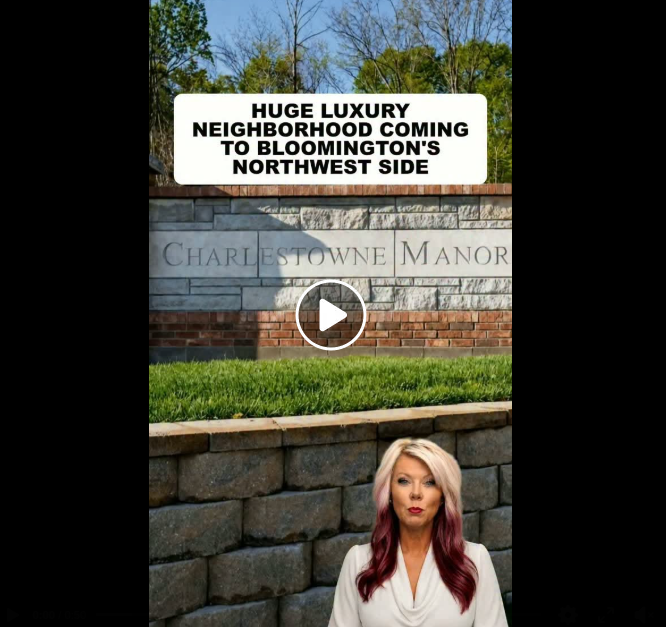
Natasha Johns, a Bedford-based realtor who works the Monroe–Lawrence corridor, posted a bright little sales pitch this month about the Summit District: a $477 million “neighborhood” of more than 4,200 homes on 140 acres next to RCA Community Park. Five neighborhoods over ten years. Shops. Restaurants. A few 12-story buildings. Forty percent of the land held as green space. At least 40 percent of the units supposed to be for people who actually buy, not just rent. Five million dollars already lined up just to design the roads. First construction bids targeted for 2027.
She smiled through all of it. That is the job. Comment “home,” she said, and she will send the details.
The details are less charming once you stop treating them like a brochure.
A City Within a City
Summit District is not a neighborhood in any ordinary Indiana sense. It is a planned unit development on the last large undeveloped tract inside Bloomington—bounded roughly by Bloomfield Road, Walnut Street, Tapp Road, and I-69. The council rezoned it in 2024. The city is now feeding it public infrastructure money through TIF. Developers talk about walkability, ownership, and “housing for all.” Neighbors have been calling it a city within a city since the first hearings.
That is not rhetoric. At full build-out the site is designed for thousands of units on 140 acres. Residents of Arbor Ridge and other adjoining streets have already pointed out the obvious: the roads, schools, and utilities around Weimer and Tapp were not built for a small town dropped onto the southwest edge of Bloomington. The city’s answer has been more design money, more density language, and the same promise that has accompanied every large project of the last decade: this time the housing will be the right kind.
Some of it may be. Forty percent ownership is better than another wall of student rentals. Fifteen percent “affordable” or workforce set-asides is better than zero. Open space on paper is better than none. None of that changes the larger pattern Bloomington has already demonstrated. New product arrives. Prices stay high. The households that used to form the year-round middle of the community keep leaving.
Where the Priced-Out Go
Bloomington’s own housing reports have already conceded the point. The metro is the most cost-burdened in Indiana. Non-student population has been shrinking. School enrollment has followed. Teachers, hospital staff, tradespeople, and mid-level university employees who cannot clear Bloomington rents do not vanish. They move to Bedford, Spencer, Ellettsville’s edges, and the other towns that still have a house they can carry.
Those towns did not vote for Bloomington’s zoning experiments, its hospitality boom, or its habit of adding units faster than it adds a stable working class that can own anything. They absorb the commute, the school-enrollment pressure, the service load, and the housing demand that originated in Monroe County’s choices. In most cases the arrangement is tolerated, not welcomed.
This is the part the cheerful posts never mention. A 4,250-unit district next to RCA Park does not automatically restore the middle class that has already been priced out of the core. If the new product is still calibrated to investors, students, and households that can absorb Bloomington prices, the overflow continues. Surrounding counties get more of the people Bloomington can no longer house at a wage that matches the local cost of living. That is not a morality play. It is an export of Bloomington’s housing failure.
The Smile
Natasha Johns sells houses on both sides of that line. She closes in Bedford and Bloomington. She knows what a Mitchell bungalow and a north-side Bloomington listing actually cost. She also knows how to write a post that makes 12-story buildings and a decade of construction sound like a stroll to coffee with the kids.
There is a particular kind of professional cheerfulness that can describe the largest remaining green tract in the city turning into a multi-phase megaproject and still end with a request to comment “home.” It is not clinical evidence of anything. It is a sales face. The unsettling part is how easily that face sits on top of a regional economy in which ordinary Indiana households are being asked to accept smaller rooms, longer drives, and weaker roots so that Bloomington can keep adding density and calling it compassion.
If the middle class is the people who buy a house, stay put, pay the tax bill, and raise children in one school system, then a development model that keeps pushing those households one county south is not a rescue. It is a transfer. The smile does not change the transfer. It only makes the brochure easier to share.
Summit District may yet produce some owner-occupied streets worth having. It may also produce another decade of construction, another round of TIF, and another wave of households who discover that “walkable” Bloomington still costs more than their paycheck. Bedford already knows how that story ends. The rest of the ring around Monroe County is learning it in real time.
Comment “home” if you want the listing packet. Comment “overflow” if you live in the towns that get whatever Bloomington cannot keep.
Thoughts · 2